

Salesforce stopped selling Configure, Price, Quote (CPQ) to new customers, and your sales team still quotes in it every day. So do you migrate now, or keep CPQ running? Here's what end of sale actually means for manufacturers, and how to decide without putting this quarter's quotes at risk.
Key takeaways
- Salesforce CPQ end of sale means no new customers and no new features, but existing customers keep support, critical fixes, and renewals.
- Salesforce hasn't forced a migration, so manufacturers can plan the move to Revenue Cloud Advanced on their own timeline.
- Moving from Salesforce CPQ to Revenue Cloud Advanced is a reimplementation: product rules, pricing logic, and ERP integrations get rebuilt, not copied.
- Manufacturers with stable quoting and no new pricing models can stay on CPQ for now, as long as they plan the move before a major change.
- A clean product catalog and a mapped ERP integration cut more migration risk than any tool or shortcut.
What Salesforce CPQ end of sale actually means
In March 2025, Salesforce confirmed that CPQ entered an "End of Sale" phase. New customers can't buy it anymore. Existing customers keep using it, get full support, and can renew their licenses as before.
Salesforce explains the change on its own page, "Navigating the Future of Salesforce CPQ". CPQ is now in a maintenance phase. You still get support and critical fixes. New product work goes to Revenue Cloud Advanced (formerly Revenue Lifecycle Management), part of the Agentforce Revenue Management suite.
For a manufacturing sales team, that splits into two very different things:
- What stays the same: your quote templates, price rules, bundles, and approvals keep working tomorrow and next quarter.
- What changes: every new quoting feature, AI capability, and integration Salesforce ships from now on lands in Revenue Cloud Advanced, not in CPQ.
So the question isn't "will CPQ break?" It's "how long do we want to run quoting on a product that won't get better?"
Is Salesforce CPQ going away?
Not soon. Salesforce calls this "end of sale, not end of life," and it says there's no forced migration. It hasn't published an end-of-life date for CPQ either.
That gives you time, but time works both ways. Your CPQ org keeps aging while your products, pricing, and channels keep changing. If you plan to add usage-based pricing, sell through a dealer portal, or let AI draft quotes, those plans point to Revenue Cloud Advanced.
Here's the manufacturing version of the problem. Running quoting on CPQ from here on is like running a production line on equipment the maker no longer upgrades. It still runs, and it runs well. But every new requirement means a workaround instead of an upgrade.
Salesforce CPQ vs. Revenue Cloud Advanced: what changes for manufacturers
Both products configure products, price deals, and generate quotes. The difference is how they're built, and that decides what you can do next.
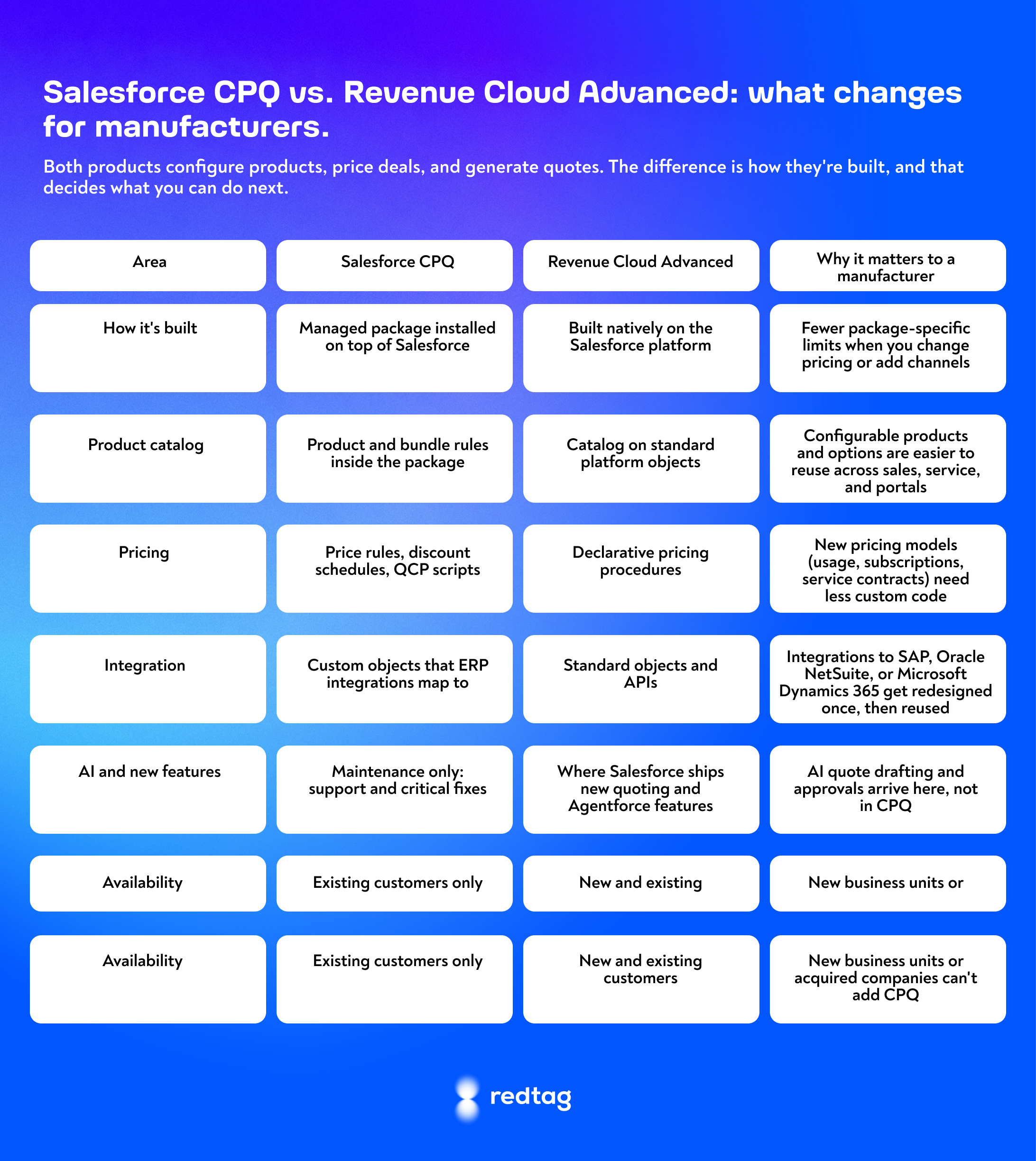
The table makes Revenue Cloud Advanced look like an easy upgrade. It isn't, and that's the part most teams underestimate.
If you want the deeper technical comparison, our team covered it in the webinar "Salesforce RCA and Salesforce CPQ: Key Differences and What's Next".
Why the move is a reimplementation, not an upgrade
Salesforce says it plainly: Revenue Cloud Advanced is not simply CPQ with a new name. There's no switch that moves your setup across. In practice, you rebuild four things:
- Product catalog and bundles. Years of CPQ product rules, options, and constraints move to a different data model. Duplicate SKUs and old bundles move with them unless you clean them first.
- Pricing logic. Price rules, discount schedules, and custom pricing scripts get redesigned as pricing procedures.
- Approvals and quote documents. Approval chains and quote templates get rebuilt and retested with your sales and finance teams.
- ERP and billing integrations. Every integration that reads or writes CPQ objects needs new mappings. For manufacturers, this is usually the biggest piece of work.
The upside: a reimplementation lets you drop the workarounds your team built up over the years. Most manufacturers we work with find rules nobody uses and approvals nobody remembers adding.
Stay or move: a decision checklist for manufacturers
Use these signals to decide when the move belongs on your roadmap.
You can stay on Salesforce CPQ for now if:
- Your product catalog and pricing models are stable for the next 12-18 months
- Quotes go out on time and reps don't work around CPQ in spreadsheets
- Your ERP integration is stable and nobody plans to replace the ERP
- You don't plan new channels, such as a dealer portal or B2B commerce
Start planning the move to Revenue Cloud Advanced if:
- You're adding subscriptions, service contracts, or usage-based pricing
- Reps build complex quotes outside Salesforce because CPQ can't handle the options
- You're replacing or upgrading your ERP in the next two years
- You want AI-assisted quoting with Agentforce
- An acquisition or new business unit needs quoting, and CPQ isn't for sale anymore
If three or more "start planning" signals apply, the move belongs on next year's roadmap. If your ERP project is coming, plan both together. Rebuilding the integration twice is the most expensive mistake we see.
We've done this with manufacturers before. A medical device maker came to us with slow quotes and manual renewals. After moving to Revenue Cloud Advanced, the MedTech manufacturer cut quote time by 60% and automated renewals.
Not sure which side of the checklist you're on? Book a free consultation and we'll review your current CPQ setup with you.
Once you know the move is coming, the next question is how to make it without disrupting sales.
How to plan your move from Salesforce CPQ to Revenue Cloud: 5 steps

Step 1: Audit your current CPQ setup. List every product rule, price rule, approval, quote template, and integration. Mark what's used, what's broken, and what nobody owns. A Salesforce Health Check gives you this inventory, ranked by business impact.
Step 2: Clean the product catalog first. Merge duplicate SKUs, retire old bundles, and agree on one source of truth for prices. Whatever is messy in CPQ stays messy in Revenue Cloud Advanced.
Step 3: Map every ERP touchpoint. Write down which system owns customers, products, prices, orders, and invoices, and how data moves between them. If you connect Salesforce and your ERP with MuleSoft, redesign the APIs once so they serve both the migration and what comes after. Our webinar "Unify Your CRM, ERP & Finance Data with MuleSoft" shows how this works in practice.
Step 4: Pilot one product line. Pick a product family with real volume but limited complexity. Run it in Revenue Cloud Advanced while the rest of the catalog stays in CPQ, and measure quote time and errors against your baseline.
Step 5: Cut over in phases. Move the remaining product lines in waves, and switch existing contracts at renewal so customers never see the change. Keep CPQ data available for reference until the last contract has moved.
Plan the move before you need it
Salesforce CPQ end of sale doesn't force your hand this quarter. It does set the direction. Manufacturers who plan now pick the timing, clean the catalog, and fold the ERP work into one project. Teams who wait often end up migrating in a rush, right when a new pricing model or ERP project arrives.
Faster quoting is the reason to do this well. In one project, AI quoting helped a global supplier cut quote time by 80%. See more of our work for manufacturers on Salesforce.
Ready to map your move from Salesforce CPQ to Revenue Cloud Advanced? Our Solution Design & Implementation team starts with a discovery workshop and gives you a migration plan your sales team can live with.
FAQ
Is Salesforce CPQ being discontinued?
No. Salesforce CPQ is end of sale, not end of life. Salesforce no longer sells it to new customers, but existing customers keep support, critical fixes, and renewals. Salesforce hasn't announced an end-of-life date.
Do I have to migrate from Salesforce CPQ to Revenue Cloud?
No, there's no forced migration. But new quoting features and AI capabilities only come to Revenue Cloud Advanced. Most manufacturers should plan the move before a major pricing, channel, or ERP change.
Can Salesforce CPQ and Revenue Cloud Advanced run in the same org?
Yes, they can run side by side. That's what makes a phased move possible: you pilot one product line in Revenue Cloud Advanced while the rest of your quoting stays in CPQ.
How long does a Salesforce CPQ to Revenue Cloud migration take?
It depends on the size of your catalog, your pricing rules, and the number of integrations. A pilot on one product line moves much faster than a full cutover. Start with an audit to get a realistic timeline for your org.
Is Salesforce CPQ still worth it for a manufacturer?
If you already run it and your quoting works, yes, for now. You keep support and renewals. But if you're choosing a quoting tool today, new customers can't buy CPQ, so Revenue Cloud Advanced is the option to evaluate.


